


News
SACL representatives discussed challenges facing administrative justice in Europe with Polish Counterparts
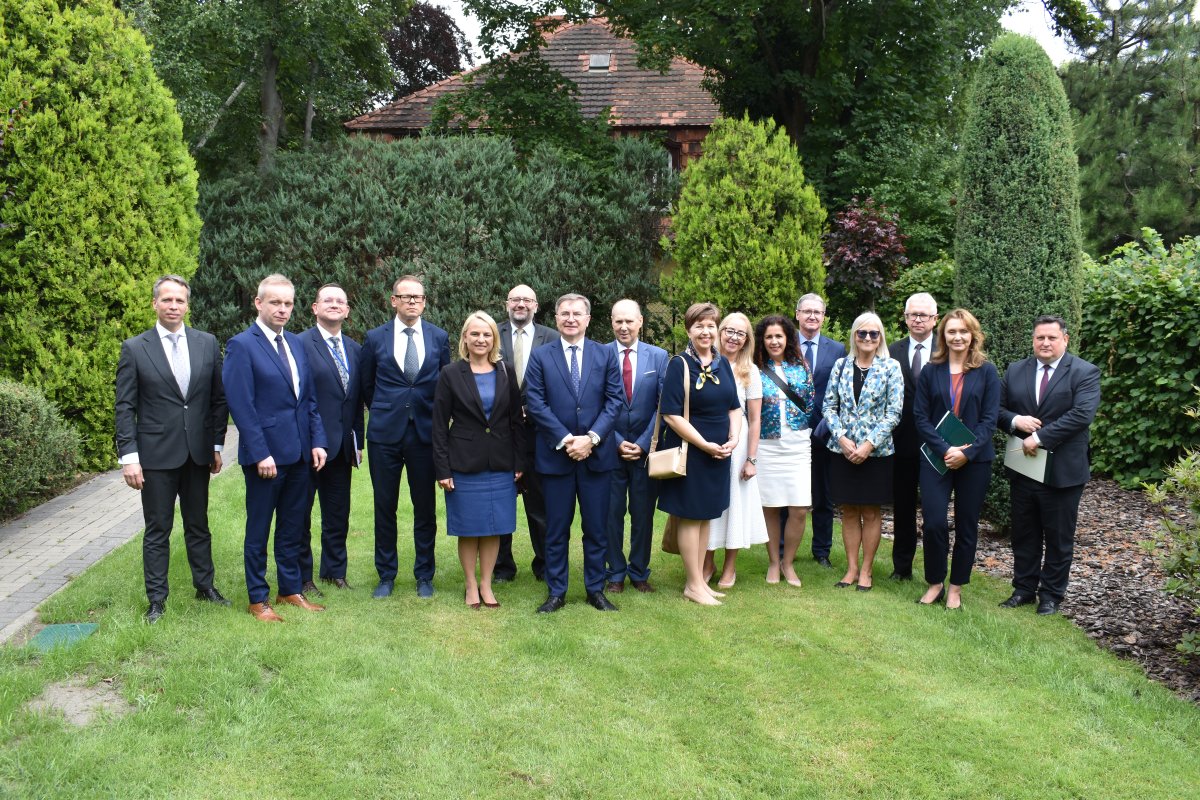
President of the Supreme Administrative Court of Lithuania (SACL) Skirgailė Žalimienė, Vice-President of the Court Ernestas Spruogis and Judge Veslava Ruskan participated in the Lithuanian–Polish seminar of the Supreme Administrative Courts held in Gdansk. The seminar was dedicated to discussing the most pressing challenges facing administrative justice and exchanging judicial experience between the two countries.
The seminar was organised in Gdansk by the Supreme Administrative Court of Poland in cooperation with the Regional Administrative Court. During the event, Lithuanian and Polish judges discussed the development of administrative justice, judicial independence, procedural sanctions, the limits of the right of access to a court, and the latest case-law of the European Court of Human Rights and the Court of Justice of the European Union.
In her opening remarks, President Žalimienė emphasised that the administrative courts of both countries are united not only by close professional cooperation but also by a shared responsibility to strengthen the rule of law across Europe.
“Administrative courts resolve disputes between individuals and the State on a daily basis. It is therefore our duty to ensure that public authorities always act in accordance with the rule of law, respect for human rights and the principles of a democratic State,” said the President of the Supreme Administrative Court of Lithuania.
She also noted that administrative courts today operate in a rapidly changing environment, where national courts increasingly deal with complex disputes involving European Union law, human rights protection, national security, migration and the legal implications of technological developments.
During the first panel discussion, devoted to the right to a fair trial, President Žalimienė raised the question of where the limits of judicial review end and where the rule of law begins to be at stake: can it be justified that acts of public authorities affecting an individual's rights or legitimate interests fall outside the jurisdiction of any court?
The discussion also examined the case-law concerning disputes over judicial careers, judicial appointments and the limits of judicial protection in both Lithuania and Poland. Participants analysed the latest jurisprudence of the European Court of Human Rights and the Court of Justice of the European Union relating to judicial independence, the right of access to a court and the balance between the competences of different branches of government in judicial appointment procedures.
Presenting the Lithuanian experience, President Žalimienė stressed that European case-law increasingly highlights the importance of effective judicial protection while at the same time recognising the need to preserve the constitutional balance of powers.
“On the one hand, effective judicial protection is an essential element of the rule of law. On the other hand, judicial appointments are inseparable from the constitutional powers entrusted to other branches of government. The key question is therefore not whether judicial review should be broader or narrower. Rather, in each individual case, it is essential to ensure a level of judicial protection that effectively safeguards individual rights while preserving the constitutional principle of the separation of powers,” the President noted.
The second panel discussion featured Vice-President Ernestas Spruogis and Judge Veslava Ruskan, who, together with their Polish colleagues, discussed the application of procedural sanctions in judicial proceedings, compared national approaches and explored ways to ensure effective court proceedings while safeguarding the rights of the parties.
The seminar also devoted considerable attention to bilateral cooperation between the Lithuanian and Polish administrative courts, the exchange of best practices and the common challenges facing administrative justice across Europe. According to President Žalimienė, an open professional dialogue between European administrative courts is an important prerequisite for strengthening public confidence in the judiciary and ensuring the consistent application of European law.


Contacts
Žygimantų st. 2,
LT-01102 Vilnius Lithuania
Phone: +370 5 279 1005
Mobile: +370 655 22502
E-mail: info@lvat.lt
Working hours
I-IV 8.00 – 17.00
V 8.00 – 15.45
Lunch break 12.00 – 12.45
Hours for receiving complaints and requests at the office:
I-IV 8.00 – 17:00
V 8:00 – 15:45
Additional hours for pre-registered persons for receiving complaints and requests at the office:
I 17.00 – 17:30
III 17.00 – 17:30
Contacts
Supreme Administrative Court of Lithuania
Žygimantų st. 2,
LT-01102 Vilnius Lithuania
Phone: +370 5 279 1005
E-mail: info@lvat.lt
Code 188734870
Working hours
I-IV 8.00 – 17.00
V 8.00 – 15.45
Lunch break 12.00 – 12.45
Hours for receiving complaints and requests at the office:
I-IV 8:00 – 17:00
V 8:00 – 15:45
Additional hours for pre-registered persons for receiving complaints and requests at the office:
I 17.00 – 17:30
III 17.00 – 17:30
Publications

Maps of courts

