


News
Heads of supreme administrative courts from around the world meet in Luxembourg to discuss the role of courts in upholding the rule of law
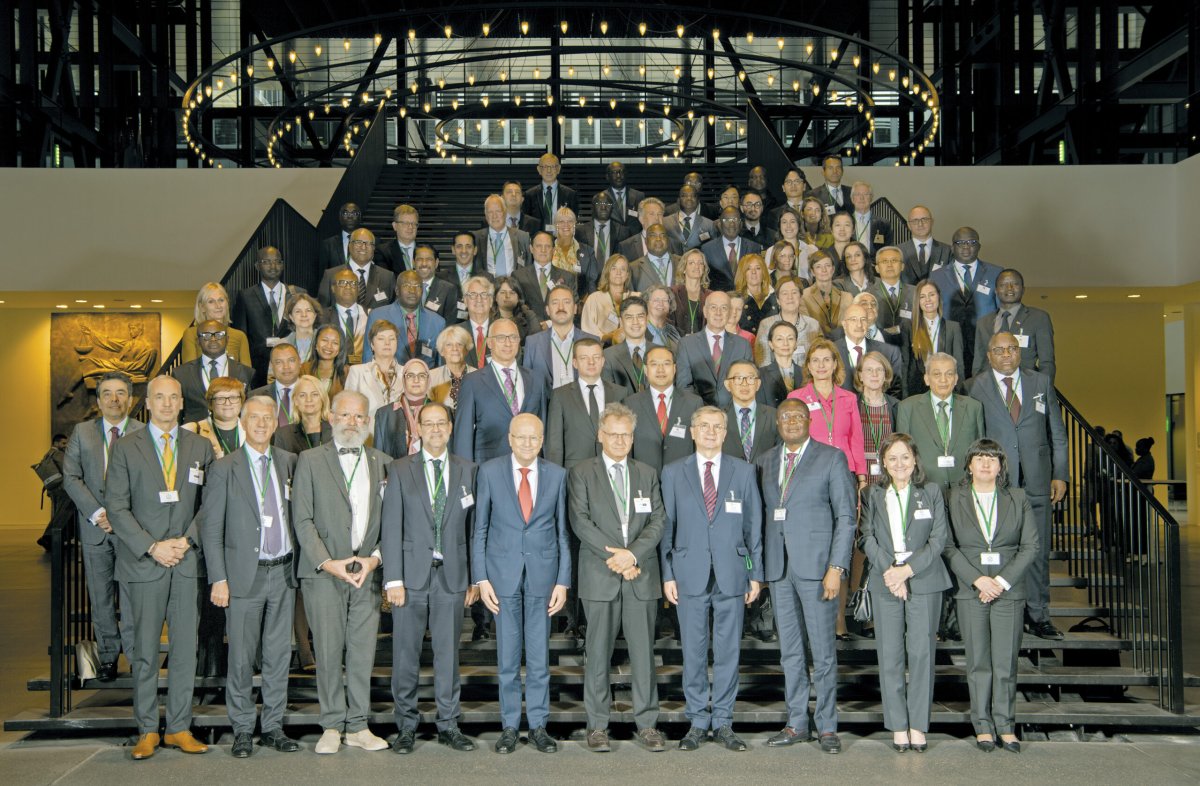
How can the rule of law be safeguarded at a time when court judgments are increasingly becoming the subject of political and public debate, while courts themselves face pressure, questions about their independence, and even resistance to the enforcement of their decisions? These issues were discussed by representatives of supreme administrative courts from countries around the world at a meeting held in Luxembourg on 17–18 September.
Dr. Skirgailė Žalimienė, President of the Supreme Administrative Court of Lithuania, also took part in the Board meeting and seminar of the International Association of Supreme Administrative Jurisdictions (IASAJ/AIHJA), entitled “The Rule of Law: Concept and Perspectives.”
On 17 September, the IASAJ Board meeting was held at the Court of Justice of the European Union, followed the next day by a seminar bringing together representatives of 40 supreme courts belonging to the Association. The meeting was opened by Francis Delaporte, President of the Administrative Court of Luxembourg, and Dimitry Berberoff, President of IASAJ and Judge of the Supreme Court of Spain. Koen Lenaerts, President of the Court of Justice of the European Union, also shared his insights with the participants.
The discussions were based on an extensive comparative study analysing responses to a dedicated questionnaire from 47 supreme administrative jurisdictions, including Lithuania. The study revealed a seemingly paradoxical trend: although constitutional traditions and judicial systems differ considerably from one country to another, there is a remarkably similar understanding of the essential elements of the rule of law.
Legality, separation of powers, legal certainty, proportionality, equality before the law, judicial independence and the right to effective judicial protection remain common points of reference across different legal systems.
The seminar placed particular emphasis on the role of administrative courts in ensuring that these principles function not merely as declarations. The first panel discussion, chaired by Jacek Chlebny, President of the Supreme Administrative Court of Poland, examined the concept of the rule of law and the particular role of administrative judges in safeguarding it. It was emphasised that administrative courts perform a distinctive function: they review the actions of public authorities and provide individuals with an effective means of protecting their rights in their relations with the State.
The second panel discussion, chaired by Suzanne Côté, Justice of the Supreme Court of Canada, focused on the challenges currently facing the rule of law and the means available to courts in responding to them.
The experiences shared by national courts show that countries are increasingly confronted with public criticism of court judgments and challenges to the role of judges, external pressure, cases attracting significant political and media attention, disputes concerning national security and public order, as well as difficulties in ensuring the effective enforcement of court judgments.
At the same time, the discussions focused not only on identifying problems but also on finding solutions. Among the most important measures for strengthening the rule of law, participants highlighted effective guarantees of judicial independence, the proper enforcement of court judgments, the availability of interim measures in urgent cases, transparency in public administration, and the ability of courts to clearly explain their decisions to the public.
The participants also discussed emerging challenges, including the use of automated decision-making and artificial intelligence in public administration and the question of how effective judicial review should be ensured in such circumstances.
According to dr. Skirgailė Žalimienė, President of the Supreme Administrative Court of Lithuania, this type of international dialogue is particularly important because the principles of the rule of law acquire their true significance not in theoretical discussions, but in the everyday work of courts.
“The rule of law is not an achievement that, once attained, simply sustains itself. Its vitality is demonstrated every day by whether an individual can effectively challenge a decision of a public authority, whether a court can reach its decision independently of external pressure, and whether that decision is respected and enforced. Meetings where courts representing different legal traditions openly discuss not only their achievements but also the difficulties they face help us recognise that many of today’s challenges are shared. Exchanging experience helps us find answers as to how administrative courts can continue to serve as a reliable safeguard of human rights and legality in a rapidly changing environment,” said dr. Žalimienė.
The discussions in Luxembourg also highlighted another important trend: despite considerable differences between legal systems and national experiences, the role of administrative courts is increasingly recognised as one of the key practical safeguards of the rule of law. It is in the courts that abstract principles such as legality, proportionality, legal certainty and the balance of powers are translated into concrete protection of individual rights in relations with the State.
The International Association of Supreme Administrative Jurisdictions brings together supreme administrative jurisdictions from different regions of the world, providing a forum for exchanging case-law and experience, comparing approaches adopted by different legal systems, and jointly seeking solutions to the challenges facing administrative justice.


Contacts
Žygimantų st. 2,
LT-01102 Vilnius Lithuania
Phone: +370 5 279 1005
Mobile: +370 655 22502
E-mail: info@lvat.lt
Working hours
I-IV 8.00 – 17.00
V 8.00 – 15.45
Lunch break 12.00 – 12.45
Hours for receiving complaints and requests at the office:
I-IV 8.00 – 17:00
V 8:00 – 15:45
Additional hours for pre-registered persons for receiving complaints and requests at the office:
I 17.00 – 17:30
III 17.00 – 17:30
Contacts
Supreme Administrative Court of Lithuania
Žygimantų st. 2,
LT-01102 Vilnius Lithuania
Phone: +370 5 279 1005
E-mail: info@lvat.lt
Code 188734870
Working hours
I-IV 8.00 – 17.00
V 8.00 – 15.45
Lunch break 12.00 – 12.45
Hours for receiving complaints and requests at the office:
I-IV 8:00 – 17:00
V 8:00 – 15:45
Additional hours for pre-registered persons for receiving complaints and requests at the office:
I 17.00 – 17:30
III 17.00 – 17:30
Publications

Maps of courts

